
Why The O-Word Isn't as Scary as it Sounds
If you grew up in the UK in the 80s, you likely remember Maureen Lipman in the classic BT advert, beaming with pride because her grandson passed his exams. “He’s got an ‘Ology!" she beamed. “People will always need an ‘Ology!"

She was right. The suffix -ology simply means ‘the study of.’ Biology is the study of life; Sociology is the study of society. Ontology (derived from the Greek onto-, meaning ‘being’ or ‘that which exists’), then, is the study of being - or more simply, the study of what a thing actually is.

The Tomato
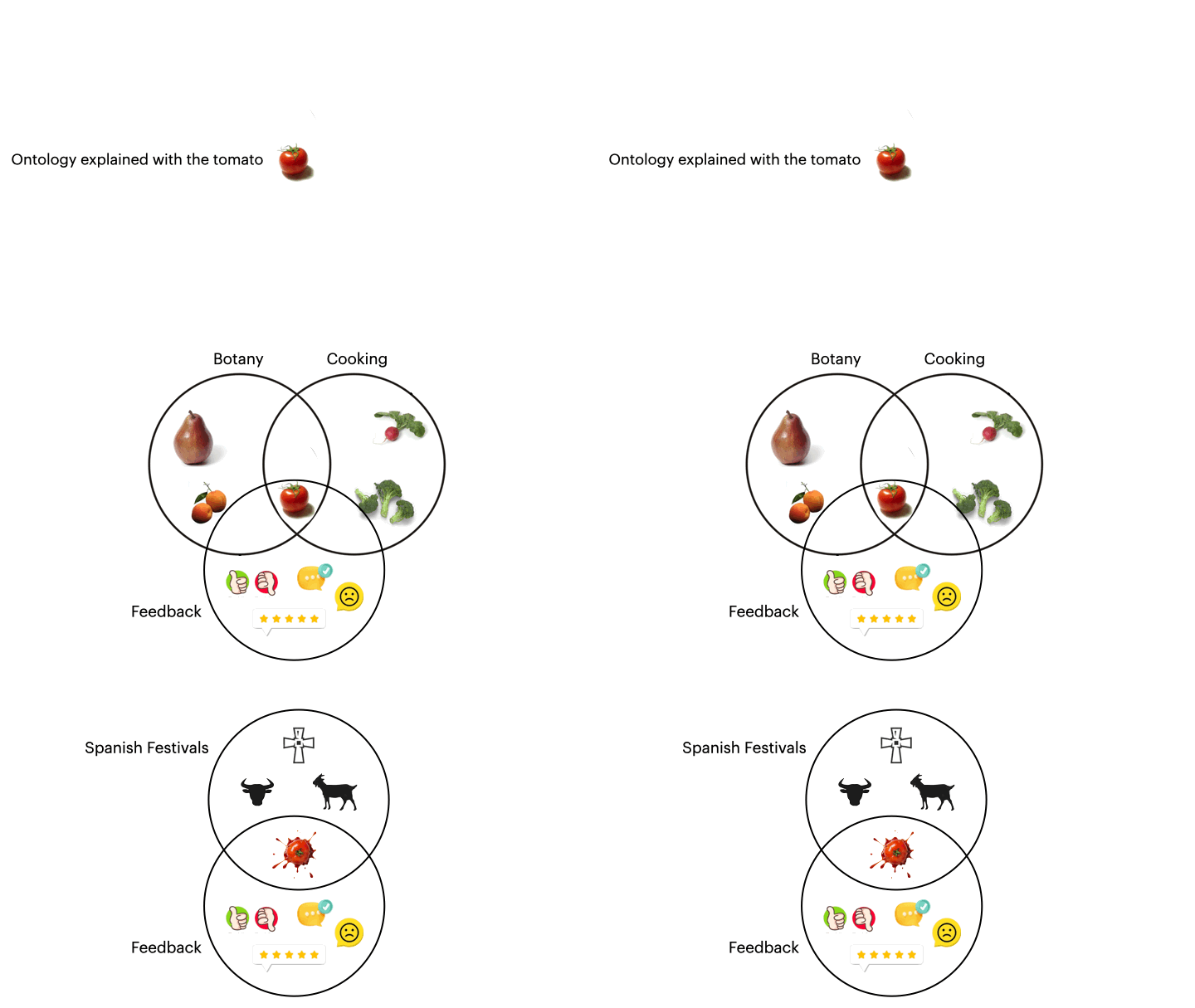
The reason ‘Ontology’ should matter more in business is that we rarely agree on what a thing is. To explain what we mean, take the humble tomato:
-
To a Botanist, it is a fruit.
-
To a Chef, it is a vegetable.
-
To a Film Critic, it is a metric of failure.
-
To a Spaniard in late August, it is ammunition for La Tomatina festival.

The tomato hasn’t changed, but the ontology - the framework of ‘what it is’ - changes completely depending on the context. In the enterprise, we run into trouble because folks work in silos where there is the one ‘right’ way to see the tomato. We lack a language that allows the Chef and the Botanist to collaborate without one of them being ‘wrong’.
Enter “Multi-Ontology”
While computer scientists in the 90s used the term to get disparate databases to talk to one another, it was Dave Snowden who revolutionised the field by introducing multi-ontology sense-making to management theory.
Snowden’s insight was a diagnostic breakthrough: he argued that we fail when we apply the logic of an ordered system (like an engine) to a complex system (like a culture). When a leader tries to use a spreadsheet (ordered ontology) to fix a morale problem (complex ontology), they aren’t just using the wrong tool; they are misidentifying the very nature of the thing they are looking at. To use the tomato again, if the head chef barks at his sous-chef to get “a load of tomatoes in” but they arrive by the ton in a truck from Buñol, then that’s an ontological error. Because they didn’t agree on the ontology (Are we fine-dining or are we hosting a riot?), the communication and subsequent operation action failed.
You are Multi-Ontological
You already navigate these ‘different ways of being’ every day. I am a Blogger, a Father, a Customer, and a Male in his mid-fifties.
-
To my daughter, my ‘being’ is defined by my role as a parent.
-
To a health insurance company, I am a demographic data point.
-
To you, reading this, I am a source of strategic insight.

I am all of these things at once. I am multi-ontological.
The Enterprise “Reconstitution” Trap
The tragedy of the modern enterprise is that it forces everything into single ontologies. When a ‘Customer’ (a complex human being) interacts with a company, the Billing department sees a ‘Debtor’ and Support sees a ‘Ticket.’ Each silo performs an Analysis as Autopsy, cutting away the parts of the customer that don’t fit their specific departmental dictionary.
When we talk about ‘Transformation,’ one of the things we are really challenged with is the need for a shared language - a way to discuss the ‘thing-to-be-done’ that survives the journey from the customer’s lived experience to the productionised product service experience. We need to be able to refer to the ‘in-between thing’ as a-mixture-of-different-stuff-in-motion-without-killing-and-dissecting-it-and-ending-up-back-where-we-started. It’s a bit of a Goldilocks test, how do we talk about things precisely enough for the engineer, tangible enough for the business lead, without ending up down rabbit holes or in the weeds when there’s lots of work to be done. Fortunately, and this is the idiot-savant point of my post, French philosophy (with some precision Mexican fine-tuning) has already provided the groundwork.

What’s Next?!
Now that we’ve hopefully demystified the ‘O-word’ and realised why those single ontology silos are failing, how do we actually name the shared work?