
The Polymathic Matrix: Architecture as "Cartographed History"
Daniel Libeskind’s early work remains lodged in my architectural consciousness. Having written my dissertation on him years ago, I’m still finding that his “praxis” - the translation of dense, polymathic theory into physical form - has only become more relevant as technological architecture struggles to balance digital abstraction with genuine human memory.
Libeskind didn’t just build (in fact for quite a while he really didn’t!); he deciphers. His signature ideas represent a career-long effort to turn the “invisible” data of history into a “visible” tectonic language. Rather than a fixed blueprint, his work functions as a rhizome - a Deleuzian map of connections that has no beginning or end, only middle-points and offshoots.
1. Architecture as Notation: Micromegas and Chamber Works
- The Exploded Geometry (Micromegas, 1979): Named after Voltaire’s satire, these “mathematical meditations” function as a Derridean trace, where the presence of the drawing is always haunted by the absence of traditional Euclidean space. They shatter the perspective of the “Enlightenment observer,” replacing it with a multi-layered, shattered geometry that anticipates his later built works.
The Musical Score (Chamber Works, 1983): These are not representations of buildings; they are explorations of how mathematical proportions can move between the ear and the eye. By using the line as a “vibrational” element, Libeskind treats the paper as a field where music is decoded into a spatial frequency.
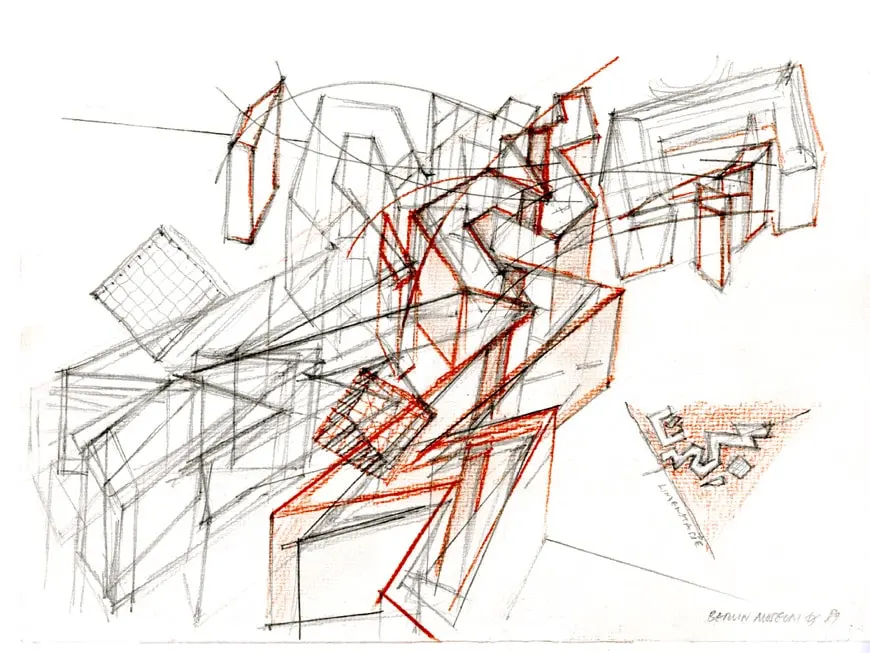
2. The Polymathic Matrix: Mapping the Gedenkbuch The design of the Jewish Museum Berlin represents the pinnacle of his polymathic approach. He didn’t just design a building; he “mined” the city of Berlin for its lost data to create a matrix of absence.
-
The Gedenkbuch (Memorial Book): Libeskind utilised the names, birthdates, and deportation sites of murdered German Jews as spatial coordinates.
-
[Urban Vectors]: He plotted the addresses of prominent Jewish and non-Jewish Berliners (such as Paul Celan, Mies van der Rohe, and Rahel Varnhagen). By drawing lines between these points across the city, he created an “irrational” web of connections. A map of intensive processes - the pressures, flows, and historical “speeds” that shaped Berlin before they were frozen into the **“extensive” **(physical) form of the building. By drawing lines between these points, Libeskind isn’t just making a pattern; he is tracing the gradients of Berlin’s trauma.
-
The Collapsed Site: He then “collapsed” this city-wide map onto the museum’s footprint. The building’s famous zigzag shape is a physical distillation of these urban vectors - a 3D diagram of the broken relationships between the city’s citizens.

3. The Architecture of Absence and “The Void” Perhaps the most persistent notion in Libeskind’s lexicon is The Void. This concept moved from theoretical drawings into the physical reality of Berlin and the World Trade Center Master Plan.
- The Visible vs. The Invisible: In Berlin, the “Void” is a straight, empty line of raw concrete that slices through the zigzagging building. It represents the “erasure” of Jewish life—a space that is physically present but functionally inaccessible.
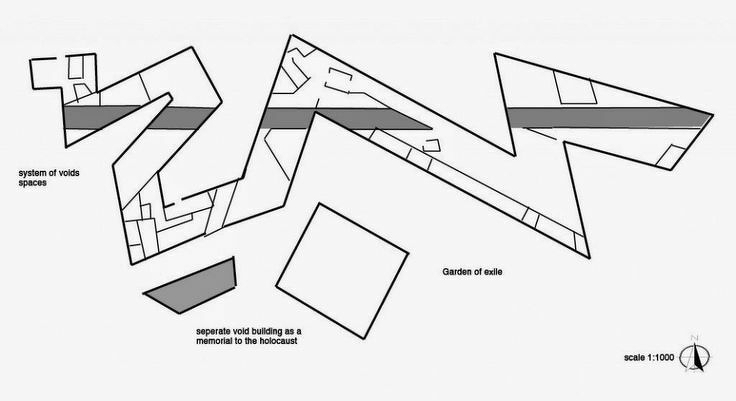
- “Between the Lines”: Libeskind’s philosophy posits two lines of logic: one is the “visible” path of history we walk, and the other is the “invisible” line of what has been lost. The building exists in the tension (the “interstitial space”) between these two.
4. The Garden of Exile: A Polymathic Critique The Garden of Exile (originally the E.T.A. Hoffmann Garden) is where Libeskind’s architectural praxis takes a sharp, intellectual “swipe” at historical trivialization.
- The Structural Critique: By invoking E.T.A. Hoffmann - the 19th-century Prussian judge and author - Libeskind critiques the “Universal Man” of the Enlightenment. He takes aim at a culture that celebrated intellectualism while simultaneously bureaucratizing Jewish identity.
- The Physical Nausea: The garden consists of 49 concrete pillars on a $12^{\circ}$ tilted foundation. Walking through it causes literal physical disorientation. It forces the visitor’s body to feel the “instability” of exile - a direct challenge to the notion that history can be neatly filed away or rendered “safe” through simple naming.
5. From Shards to the Global Studio Since founding Studio Libeskind in 1989, he has scaled these radical ideas into global landmarks like the Royal Ontario Museum (ROM) and the Danish Jewish Museum.
-
The “Crystal” and the “Shard”: These forms break the “box” of modernism, using sharp angles to create energy and tension.
-
The 17 Words: His studio maintains a vocabulary of 17 core “spiritual” words (such as Memory, Hope, Shard, Void) to ensure that even commercial projects retain his poetic and philosophical DNA.
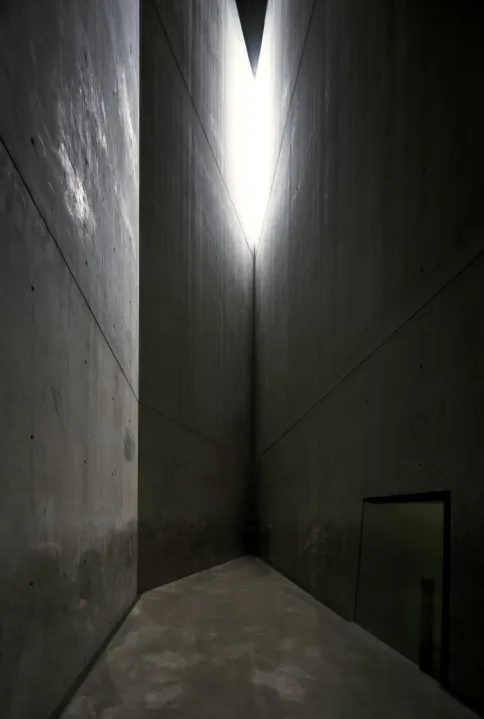
Libeskind’s legacy is the transformation of architecture into a narrative medium - where a building is not just a structure, but a “calculated history” of absence - what is no longer there. If one were to ask Manuel DeLanda to describe the “Between the Lines” diagram, he would see it as a phase space - a map of all the possible historical and emotional states of Berlin, “actualized” into a singular, jarring concrete form. It is the architecture of material complexity where the “irrational” vector is the only honest way to map a system that has undergone a catastrophic state-change.