
Libeskind's Drawings and Revolt Against The Masterplan
Daniel Libeskind’s Micromegas (published in the late 1970s, specifically 1979) remains one of the most disruptive “anti-blueprints” ever conceived. At the time, Libeskind was the head of the Department of Architecture at Cranbrook, and he was effectively staging a revolt against the “Master Plan.”
He didn’t see these drawings as illustrations of buildings, but as “Mathematical Meditations” on the act of space-making itself.
The “Conflict of the Vector” Libeskind described Micromegas as an exploration of the “End of Space." He wasn’t interested in the “Static Object” (the building); he was interested in the Point of Collision.
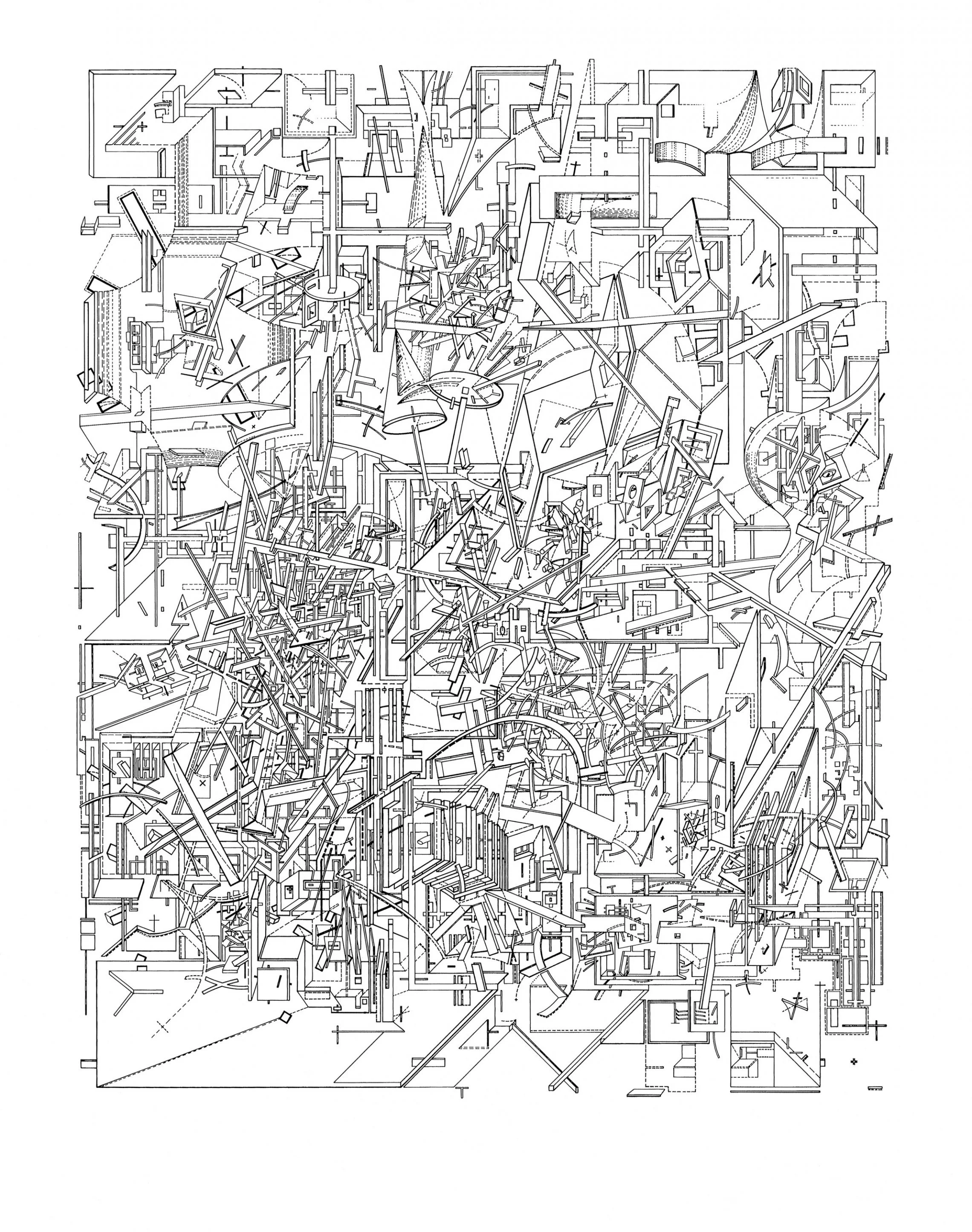
What he said: He argued that traditional architectural drawing had become a “servant of the industry” - a dead language used to provide instructions for construction. Micromegas was his attempt to liberate the drawing. He described the work as a “Calculus of the Architectural” - a way to map the “invisible forces” and “vectors of intent” that a standard floor plan ignores.
The Name: Voltaire and the “Tiny-Giant” The title refers to Voltaire’s 1752 novella Micromégas (literally “Small-Large”), which features a giant from Sirius visiting Earth. Libeskind used this name to signal a Scale Collapse. He claimed that in these drawings, “Scale is an illusion." A single line could represent a city wall or a microscopic fracture in a database. There’s a transductive link. He was “leading energy across” from the astronomical to the infinitesimal. He said the drawings were about “The Verticality of the Mind” crashing into the “Horizontality of the Site."
The “Polyphonic” Drawing Libeskind explicitly linked the work to music (specifically his Chamberworks series).
What he said: He described the drawings as “Polyphonic," meaning they contained multiple, simultaneous truths that didn’t resolve into a single “Target State.”
How this Sutures into my “Applied Transduction” thinking Libeskind’s 1970s swagger helps to dismantle the modern “Target State” architecture of the enterprise. In 1979, Libeskind gave us Micromegas to show us that the ‘Master Plan’ is a tomb. He showed us that the real work happens in the ‘Small-Large’ - the infinitesimal moment where a vector of human intent hits a technical constraint. We shouldn’t be drawing a roadmap; we need to be mapping the polyphonic collisions of the Cloud monolith.