
What if Mathematics and Philosophy Drew the Same Pictures?
Think about it: two radically different fields, arriving at the same picture for completely different reasons. Two decades ago, I was deep into Deleuze and Guattari’s A Thousand Plateaus (ATP). For the uninitiated, ATP is a wild ride - philosophy on a mission, exploring complex systems, networks of power, and how everything is connected. It’s dense, difficult, and brain-bleedingly brilliant.

Then I found the bridge. A Delandian bridge, if you will.
I’m referring to Manuel DeLanda’s Assemblage Theory, as presented in his EGS lectures. Assemblage theory explains how entities - ideas, social movements, physical objects - come together to form a coherent whole and then just as easily break apart. It’s about the emergent properties or rather capacities of these assemblages and how they affect and interact. But even with my Deleuze background, it was tough going until in 2018 I encountered the work of Marc Ngui.
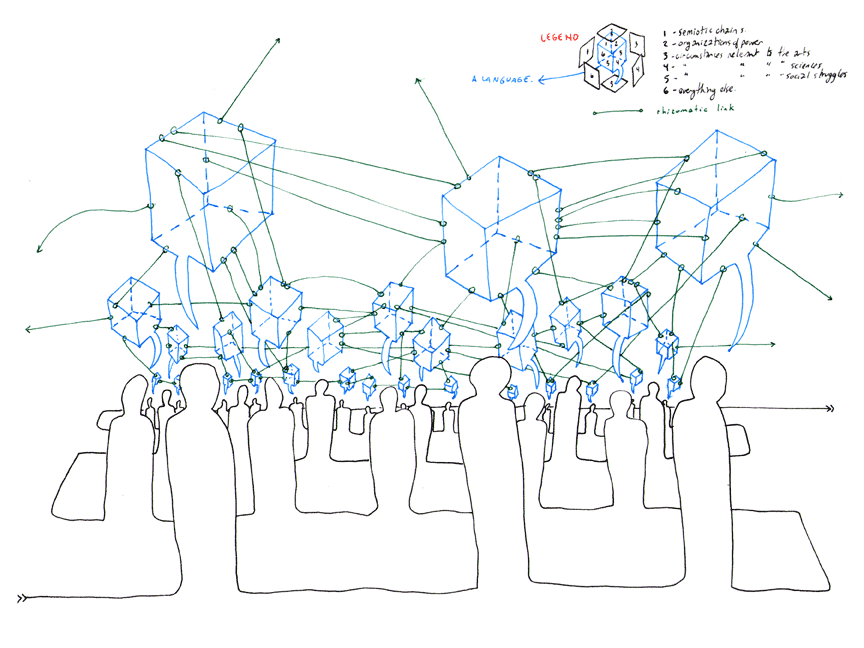
Ngui’s illustrations of ATP are remarkable. They aren’t just art; they are visual maps of abstract Deleuzian concepts. I’ll be honest: they are really, really hard to understand at first. One should definitely not try too hard. In one sitting. The ATP book is dense, and the illustrations follow suit. You have to let them seep in, or soak. It takes a while. Anything to do with Deleuze may sometimes be difficult, but is most certainly worth the effort.
But here is what I can tell you: in the theory and the illustrations lies a way to represent the topology of things we encounter and witness every day but lack the lexicon to articulate. Social networks, platforms, self-directed learning, pseudonymous identities, the network effect, and all the laws, Poe’s, Godwin’s, Cunningham’s and The GIFT….

In assemblage theory, whatever ‘it’ is, there’s a topology for that. And, it turns out, a diagram. It’s a deeply architectural way of seeing the world.
During this soaking period, I then come across Category Theory applied to the Glass Bead Game Now, bear with.

Category Theory is a highly abstract branch of mathematics that looks at structures to find commonalities between them. It’s the ultimate tool for finding the underlying pattern between things that look completely different. Category Theory is often called ‘the mathematics of mathematics’. (The Glass Bead Game is, for the purposes of this post, just a novel about everything - a fictional, high-stakes intellectual contest that serves as the perfect vehicle for the mathematics of complexity).
And that readers, was when I had what alcoholics refer to as, a moment of clarity.

The visual interpretations of Deleuze and Guattari’s philosophy are remarkably similar to the diagrams of Ehresmann’s Memory Evolutive Systems (MES), a framework within Category Theory used to model complex, multi-level evolutionary systems.
It was like seeing two people on opposite sides of a wall, but in a room in another part of the world, drawing the same thing.
The Delandian Warning
Now, a word of caution. Manuel DeLanda explicitly warns us about the similarity of appearance. He argues that grouping things together because they look the same on the surface is a trap - it’s the taxidermy of thought. Just because two things share a shape, (or share properties), doesn’t mean they share capacities. To DeLanda, the real value lies in the similarity of relations. It’s not about how it looks, it’s about how the parts of the assemblage come together to affect or be affected.
So, do they?
Do the parts of Category Theory and the parts of Assemblage Theory connect and interact in the same way, even though they come from such different ontologies?
Well, they are both describing the mechanics of emergence. In Assemblage Theory, the ‘parts’ are heterogeneous (people, tools, ideas) and their interaction creates a ‘whole with new capacities’. In Category Theory , the ‘parts’ are objects and their interactions are morphisms; and just for sh*ts and giggles, when they huddle together correctly, they form a Colimit - a new, higher-level object that represents the unity of the parts. But that doesn’t matter right now.

What the MES system Ehresmann describes is strikingly similar to the concept of Strata in Deleuze & Guattari’s A Thousand Plateaus. In fact the graphic convention that Ngui came up with for Strata is very similar to the conventions Ehresmann/Béjean used in their diagrams to show how complexity emerges.
Here is the first MES image that features multiple “cones” (clusters) converging into a single point.
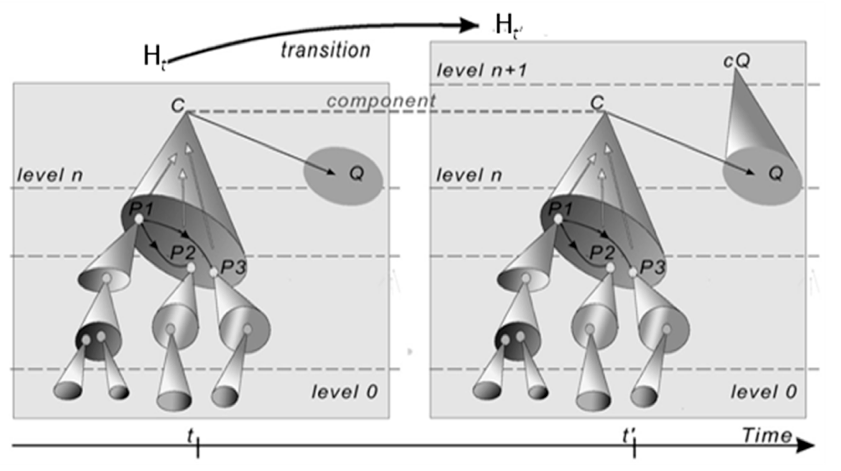
Here is paragraph 9a, which establishes the “Strata.” Ngui draws horizontal layers that mimic the leveled structure of MES. It visually represents the idea of “sedimentation” - where lower-level elements (Level 0) are captured and organised into higher-order strata (Level n+1), exactly like the “cones” in the MES image.
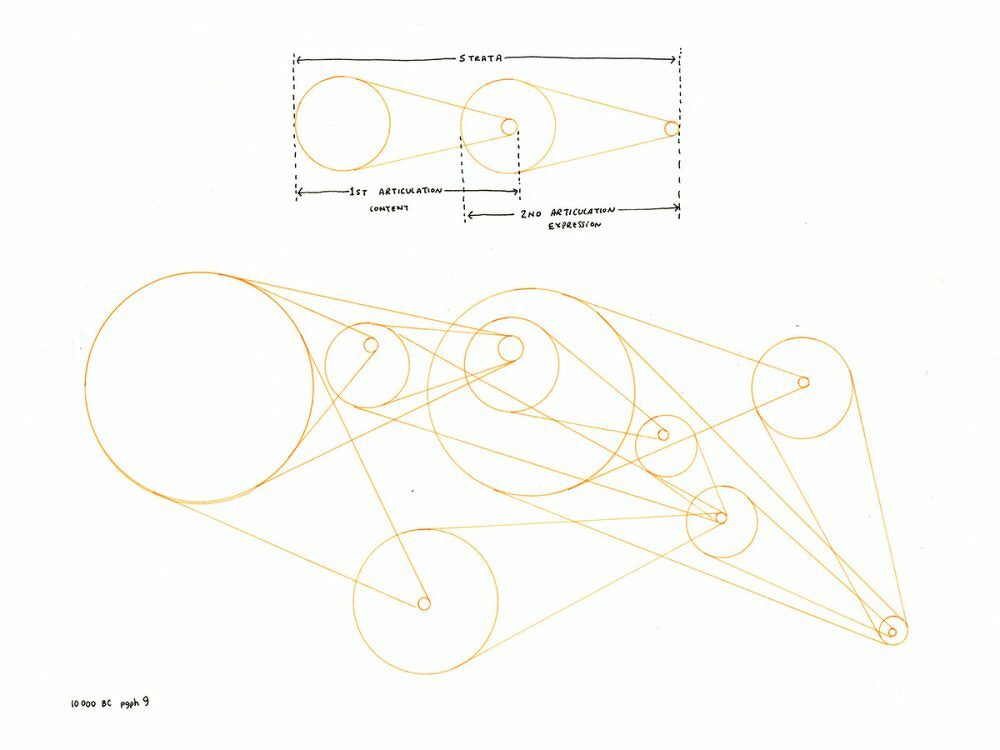
And here is the development of Strata, in A Thousand Plateaus paragraph 24.
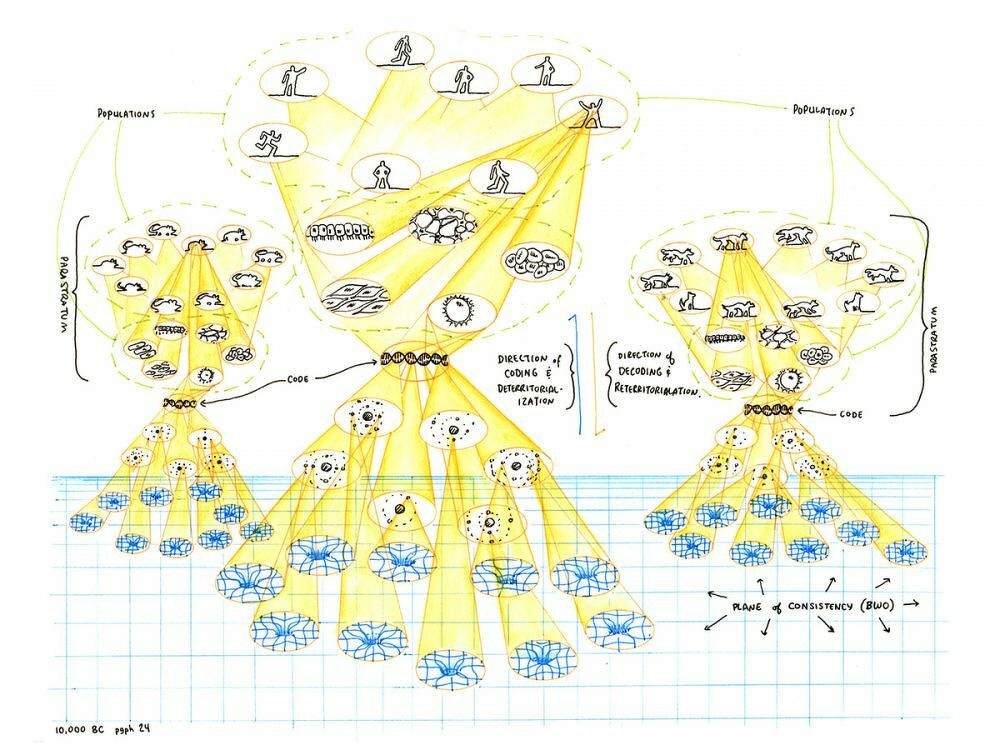
Visually, these drawings use a split or dual-panel logic to show how one level of organisation (the molecular) is translated into another (the molar). This mirrors the MES diagram showing the transition and transformation of components across different time intervals.
The invariant of these diagrams is the same Abstract Machine.
In 2019, I talked about this with Marc Ngui who excitedly agreed and remarked that ‘It was rather uncanny.’
”The MES system described in the [Glass Bead Game] article is really closely aligned to the dynamic structures D&G are describing in 10,000 BC. It is like MES is a mathematical/logical description of Strata. ..There is probably a chance that Guattari was taking ideas from Category theory to incorporate into their concept of Strata. The concept of moving from inorganic material to complex organic structures as described in the Revisited Bead Game is mirrored in D&G’s description of the progression of matter from the plane of consistency to the human organism and then to culture and language. So interesting!” Marc Ngui
A Tale of Two Approaches
In reality, both fields are observing the same hybrid reality - a Flat Ontology - for us, that means where humans, code, and hardware exist on the same plane. They simply offer two different ways of looking at it:
-1. The Assemblage Lens: Context and Capacity
Think of a sports team during a match on the pitch. You have players, the ball, the grass, and the ‘vibe.’ This is an Assemblage. It doesn’t distinguish between the biological (the players) and the technical (the pitch). It is is topological and historical. It asks: How did these specific parts come together right now? What can this combination of humans and gear actually do? We are mapping the territory of emergence. For the business, this is the “as-is” state of a transformation - the messy reality of human culture, market pressure, and existing workflows.
-2. Category Theory & MES (The Formula)
Now, look at that same match through the lens of Category Theory. It doesn’t care if the star player is wearing the No. 10 shirt; it cares about the Position (the ‘Playmaker’). It ignores the _flavour _of the components and looks at the universal functions, the morphisms connecting them. For Tech, this is the enterprise architecture - the blueprinted logic that should hold true regardless of who is performing the task or which server is running the code.
It isn’t that one theory is for humans or one visual is for machines; it’s that they are two different ways of observing the same hybrid reality. And as the diagrams and drawings reveal, fascinatingly, they coincide and corroborate each other.
-Assemblage Theory (The Map of Capacities): AT is about History and Affect. It looks at a sociotechnical system (like a DAO or a smart city) and asks: ‘What are the specific components here, and what can they actually do together?’ It recognises that a server and a human operator form a new machinic phylum It’s about the territory - the messy, shifting, specific reality of how things have actually plugged into each other.
-Category Theory (The Map of Functions): CT is about Structure and Transformation. It looks at that same system and asks: ‘What is the universal logic that governs how these parts interact?’ It doesn’t care if the object is a human or a database; it cares about the morphism, the change, between them. It’s about the rules of the game - the abstract blueprints that remain true even as the parts swap out.
The Convergence: Poised-for-the-Next-Move-
Despite their different origins, both the philosophical diagrams of Deleuze/DeLanda and Ehresmann/Béjean’s mathematical diagrams both depict a system that is stable enough to exist, but fluid enough to change. They represent a network that is poised. Architecturally, and as a student of Libeskind, I find the similarities in the diagrammatic projections of both theories and their drawings fascinating because they are a betweeness. In a Delandian sense they have - both Similarity of Relations and Similarity of Appearance.
-The Context (The Philosophical Patterns): This is offering a path for transformation. By viewing the system as an assemblage of capacities, one sees the lines of flight - the places and spaces where the culture and the tech are already shifting and ready to self-organise into a new way of working
-The Logic (The Mathematical Patterns): This is the tool for managing complexity and technical debt. By viewing your system as a category of positions and interfaces, one finds the common patterns that allow for interoperability across different eras.
By multiplexing the Teleology of Category Theory (the functional logic) with the Topology of Assemblage Theory (the historical context), we might even stop treating ‘Tech’ and ‘Business’ as separate worlds. We might start seeing them as a single Sociotechnical Assemblage poised for transformation.
And then, at that moment, I stop. Because here I start thinking about Cynefin and liminality, and Dave Snowden’s brilliant Three A’s frameworks (Agency, Assemblage, Affordance), and it’s territory that has been interrogated by folks-smarter-than-moi.

But the questions this diagrammatic comparison prompts are compelling and invite further lines of latent enquiry like:
- Are there niche diagrams in Assemblage Theory that might affect Category Theory? What is the diagrammatic capacity between the theories to affect or be affected?
- Can we use the Similarity of Relations in either theory to predict or anticipate when a system is about to shift from a static, legacy block to a capacitive assemblage?
- Does the geometry of architectural projection and drawings - which the architect Libeskind argued were autonomous spaces of exploration - bring a new territory?
Deleuze wrote a great deal about the diagram but that’s for another post.
So, what if mathematics and philosophy did draw the same diagrams?
Well, we get patterns. But these aren’t just pretty shapes on a whiteboard or wallpaper. These patterns appear as a similarity of relations. By diagramming the teleology of mathematics (the logical where are we going?) with the topology of philosophy (the structural where are we now?), might we map a new or different kind of diagram?
The diagrams coincide here because we’ve held off looking at the things and opened ourselves to looking at the relationships. And in a world of rapid transformation, whilst we think it’s the “things” that matter - the patterns tell a different story.