
The Elephant in the Room Has No Name
It is almost a requirement of the genre that any discussion of enterprise fragmentation begins with the parable of the Blind Men and the Elephant. You know the story: one touches the trunk and proclaims it a snake; another touches the ear and calls it a fan; a third touches the leg and insists it is a tree, it’s tail is a rope and so on. They aren’t wrong; their ontologies are coherent but bounded. It is the whole that is, as a consequence, fragmented.

In the modern firm, we have industrialised this blindness and turned the parable into a permanent operating model. Designers touch the user journey. Engineers touch the tech stack. Finance touches the cost centre. Each silo describes a different thing, and the Boardroom is left trying to mandate efficiency and value release to steer a thing it can neither see, nor name.
1. Analytical Autopsy
One observes a repeating pattern since the mid-2010s. Digital transformation has largely been an exercise in crossing fingers and making a wish.

Firms have spent trillions globally on going digital genuinely without much of an understanding of where or how that transformation would occur and where it would end up. Somehow, the elephant was just going to emerge.
But the friction runs deeper than a few failed projects. It stems from a way of processing reality that predates digital entirely, the analytical autopsy.
Driven by industrial need for linear outputs and annual budgets, firms can’t help but flatten customer intent - analysing research and feedback until customer intent is gone. Teams in production workflows then have to ingest those inert parts. Agility and product ways of working haven’t much hope of fixing this; they simply speed up the consumption of those autopsied products. There is still no shared understanding of how the parts works together in the cause of the whole firm serving the whole customer.
2. A Topology of Value
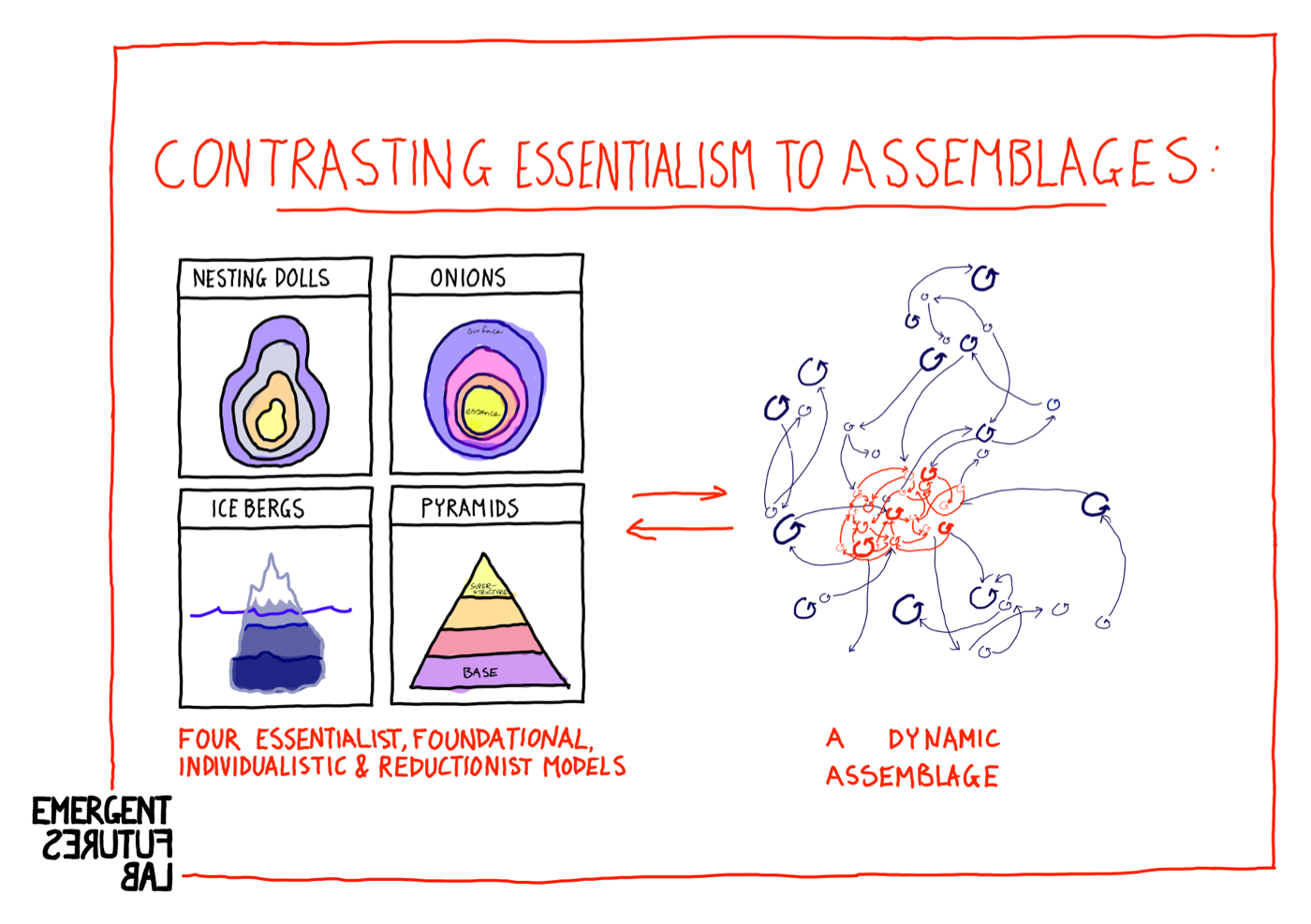
A way out isn’t a better roadmap or more integration. It’s a recognition of the actual Topology of Value. A firm may represent itself as an Org Chart. But its topology of value is an Assemblage.
The Org Chart is a map of command and control. If one’s primary concern is status, or the preservation of a rigid hierarchy, then the pyramid is a perfect topology. It is designed for reporting and oversight. But if one cares about value, the pyramid is a policy constraint. It forces a focus on local optimisation making silos efficient - but strangling global throughput of customer intent. Value involves a different map, an Assemblage.
To describe it in its very simplest terms, an assemblage is a functional-composition-of-heterogeneous-parts. It is an intensive sociotechnical entity where the parts (people, code, data) retain their own properties and their ‘living’ signal, and are synthesised into a functional whole. Right now, this composition is invisible to the boardroom. It persist in the shadows, sustained by informal workarounds and heroic individual efforts that are never funded or formalised because they don’t fit on the grid. But at least you now have a name for it. And fortunately, it is not just a label, it has its own rigorous dynamics.
Where the Org Chart is a diagram of static boundaries, the Assemblage is a map of flow. By naming the Assemblage, one makes the topology of value across the firm legible. One stops trying to manage a collection of inert parts (the consequences of that analytical autopsy) and one starts managing a synthesis.
3. The Neutrality Trap
We often treat our corporate tools and structures as neutral objects. We fall into the trap of thinking, ‘the process doesn’t run the company, people do’. On the face of it, this is true. A CRM or a project framework sitting idle is just a dormant set of rules.
What this fails to recognise is that when a person is plugged into a specific structure, they are fundamentally changed. They become a person + tool + environment unit. This unit - the Assemblage—has its own agency. It transforms the people within it, shaping habits, practices, and subjectivities. It makes certain outcomes (like siloed thinking or slow approvals) far more likely than others. The Assemblage is never neutral, and it is never passive. It has a dominant propensity. If you inhabit a modern enterprise, you should already recognise this.
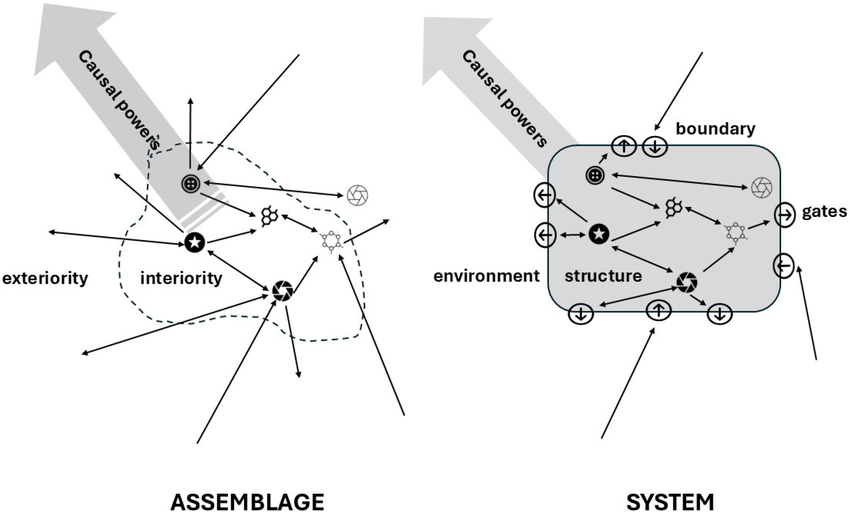
Look at the diagrams of the most valuable sociotechnical practices being shared and carried out right now - whether it is Team Topologies, Value Stream Mapping, or Domain-Driven Design. These are not just new ways of working; they are the first attempts to diagram and manipulate the Assemblage(s). They are attempts to move from the internalisation of siloed knowledge to the externalisation of a shared flow. They are naming and framing the domains, boundaries, and flows that keep the ‘molar’ (the hard, structural stuff) from crushing the ‘molecular’ (the wet, living signal of the customer). This, the Assemblage, is the strategic language of the new sociotechnical enterprise. It is the thing the firm couldn’t see and couldn’t name.
4. A Strategic Scaffolding
This is why we have been insisting on the term Assemblage. It is the foundation of a strategic scaffolding and the deliberate construction of the environment that authorises new habits. A dynamic, adaptive topology that provides coherence without stifling the autonomy of the parts.
Operating as an Assemblage unlocks a spectrum of capabilities: from precision of resource allocation to compression of the feedback loop, all while transforming around the integrity of the customer signals from first insight to final output. It defines the firm’s capacity to affect and be affected by the market. And it is the difference between a firm that is stuck in its own internal representation and one that is finally understanding its own topology of value.
Foundations & Further Reading
For those wanting the more on the Assemblage and scaffolding, the following sources provide the primary theoretical and scientific rigour:
Manuel DeLanda: Specifically his Lectures on Assemblage Theory, which provide the materialist logic for the capacity to affect and be affected.
Dave Snowden (The Cynefin Co): On Scaffolding and the shift from fail-safe to safe-to-fail experiments in complex domains.
Emergent Futures Lab: A contemporary and highly accessible diagnostic on The Neutrality of the Assemblage.
Ben Zweibelson (Military Design/JSOC): On the use of a Tornado Metaphor to Build an Assemblage Concept to diagram the kinetic and non-linear flow of assemblages in high-stakes environments.
Gilles Deleuze & Félix Guattari: A Thousand Plateaus The nonlinear emergence of the Assemblage (agencement). This is the definitive materialist critique of the Org Chart, though it is written with a deliberate, maddening resistance to being managed. It’s less a textbook and more like a terrain. If you have the appetite, go straight to Plateau 12: Treatise on Nomadology, which contrasts the static, bureaucratic state apparatus (the Org Chart) with the war machine - a fluid, goal-oriented assemblage designed for speed and reconfigurability.
Source: London Review Bookshop.
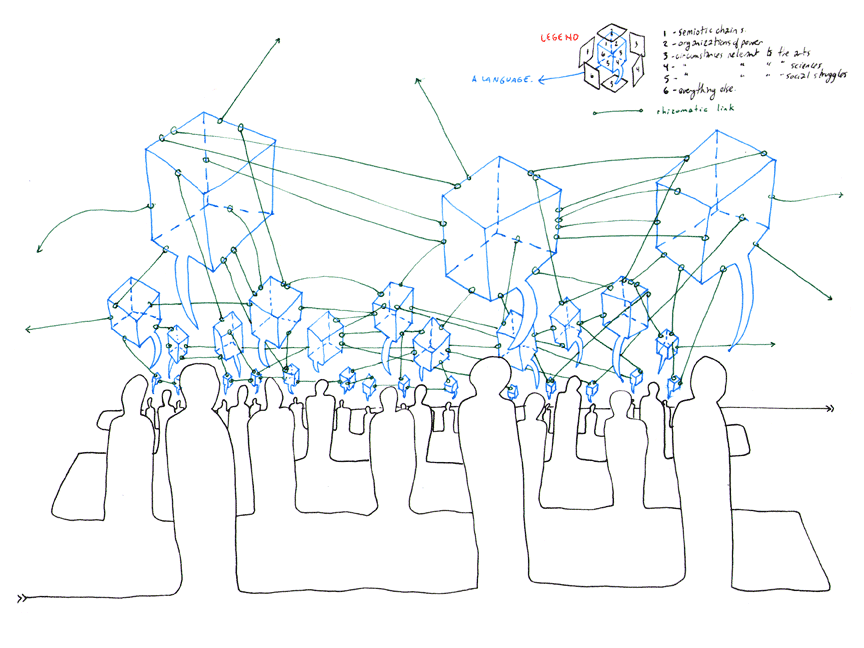
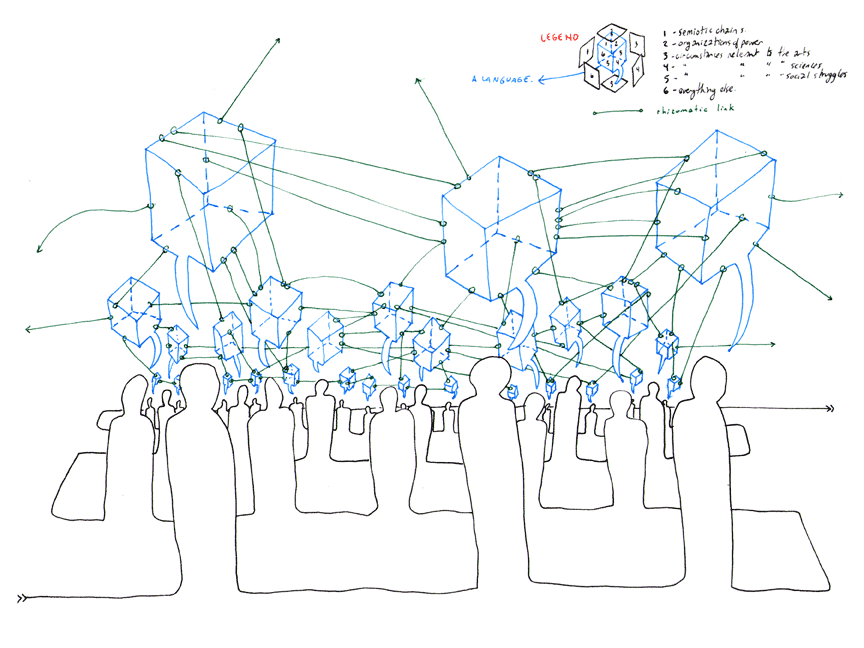
A Cheat Sheet: Marc Ngui’s Illustrated Plateaus provides a visual, topological breakdown for those who prefer the blueprint to the prose. Ngui’s favourite (and most cited) illustration for this is the Plateau 1: The Rhizome diagram. It depicts a system that has no central core but is held together by its connections - a map of flow and a visual blueprint for the strategic scaffolding described in this post.
If you want to track how one actually understands the dynamics of the assemblage, as a topology of value, you will find my ongoing explorations and blueprinting here and on LinkedIn.