
Transduction - to lead across
Fancy a bit of ‘vector logic’? No? Never mind - you’re already doing it.
You arrived here a few seconds ago and made a snap judgment: (“This looks worth clicking on”) That’s abduction - a bet on the best available explanation for why you clicked. Now, as you read this sentence, you’re inducting: scanning these words and lines to see if the pattern holds. (“Hmm, jury’s still out”) If you already know your Latin, you may have deduced where this is going before you even reached the end of this paragraph (“This is going to get philosophical. And yet, here you are”)
Three modes of reasoning. You’ve just used all of them.
Ducere is Latin for “to lead” - and the root is hiding in plain sight. Deduct. Induct. Abduct. Each prefix names the direction your mind is being led along.
Deduction leads down (de-). From a general rule to a specific conclusion. The strategy deck. The mandate from above. You already know this word: you de-duct on your tax return.
Induction leads in (in-). From many specific observations to a general truth. The survey, the NPS score, the quarterly themes report. Your kitchen hob works the same way.
Abduction leads away (ab-). From a lone observation to the best available explanation. The design sprint hypothesis: “We think the problem is X - let’s test it.” The everyday version is darker: to abduct is to kidnap - same root, only the consent differs. You’re essentially stealing a conclusion before you’ve earned it with proof.
Three directions. Same root. Different coordinates.
Then there is another ‘duction’ - one that doesn’t point down, in or away.
Transduction leads across - across registers, across disciplines, across the boundaries where meaning changes form in transit. It is the act of carrying structural information through the crossing without losing it. The Latin root is old. But the word’s modern life is largely a 20th century story. You’ll find it in the specialised lexicons of genetics, electrical engineering and signal processing; Piaget borrowed it for a specific kind of reasoning and it is the cornerstone of Gilbert Simondon’s philosophy. Manuel DeLanda followed, and is arguably the most useful on it — tracing how new structures emerge through intensity rather than being handed down from above.
And yet it never crossed into the everyday vocabulary of organisations — which is strange, because a hand-off is one of the most discussed failure points in any team, any process, any transformation programme. We know where things break. We just haven’t had the word for what the crossing actually involves. Nobody talks about transducing a brief into a build, or transducing a strategy into a team. Nobody says they’re off to transduct a ball around a five-a-side pitch.

Every time Jurgen Klopp described why his setup at Liverpool worked — and after this season, we’re allowed to be misty-eyed — he was pointing at transduction, even if he never named the logic. There was a name for the tactical application, of course: Gegenpressing. But Gegenpressing was a term for the grass; it described what the legs did. The underlying logic was transduction. It wasn’t about a homogeneous decree or reaching a consensus on what to do next. The shape was emergent, not prescribed. The movement of the first player didn’t dictate exactly what the second had to do; instead, it transduced the ‘state’ of the game to the rest of the team. One player shut down the ball-carrier, which changed the meaning of the space for the player behind him, who then cut the passing lane. They weren’t doing the same thing, but they were all maintaining a similarity of relations to the ball. You couldn’t coach that by mandate. You could only create the conditions and let the signal transduce.
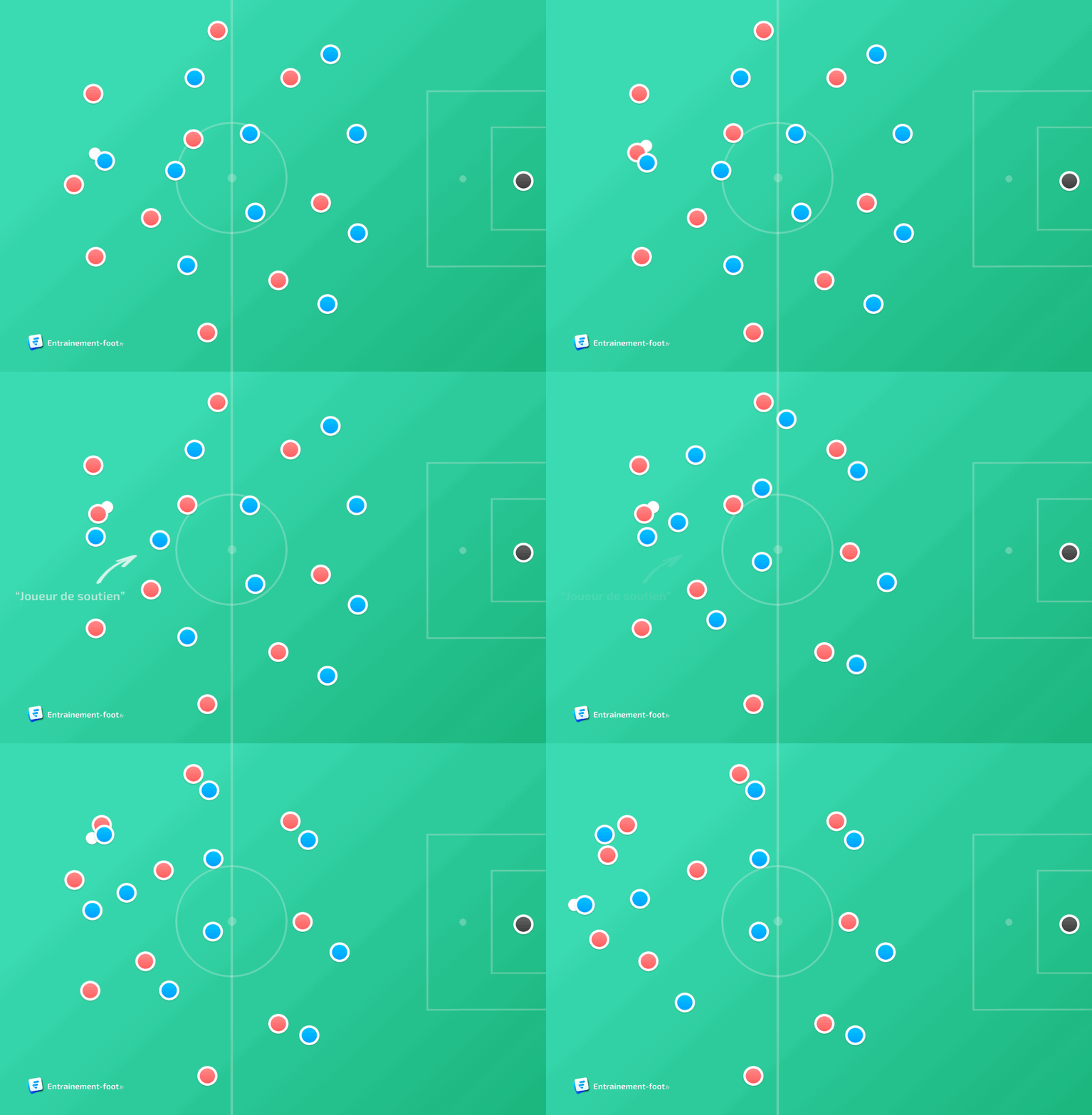
Most organisations haven’t got there. Not because the argument is wrong, but because you can’t work on what hasn’t been named yet. Klopp, of course, proved you can build the reality without knowing the word. But he had the advantage of the pitch - a high-bandwidth environment where the signal is visible and the feedback is instantaneous. In the enterprise, the signal is invisible, buried in the professional registers of different departments and teams and architectures. He could point at the grass; you have to point at the logic.
The arguments for flatter structures, cross-functional teams, value streams - the aspiration is right, and the rationale still holds. Fewer layers between the person who knows what-the-customer-meant and the person deciding what-to-build means fewer membranes for the signal to cross. That’s a signal fidelity and transduction argument. It just hasn’t been named as one.
Take the current state of the art: Suzanne Kaiser’s architecture for flow (What is it about the Germans?) Her work, like Klopp’s, builds the conditions for this movement. Neither uses the word, yet the word explains why they work. If a system in an enterprise is actually functioning, it is probably transductive.
The enterprise tried the Klopp move: it installed the value stream and rebranded departments as tribes, then waited for the magic. It never came. The org chart remained the most legible thing in the room because while the components moved, the logic didn’t. The mandate won. You can deploy squads, or standing teams but if the signal is trapped in a siloed professional register, the teams are just ‘standing-around’ in new positions waiting for a ball that never arrives. Nobody named building-the-conditions-for-that-signal-to-transduce as the actual work - and by conditions, we don’t mean breakout spaces and free coffee. We mean the structural capacity for the signal to survive the crossing.
It’s not about better translation. Think of a record deck. The needle doesn’t ‘translate’ the grooves of the vinyl into music - translation assumes the meaning is already stable and just needs a new label. Instead, the stylus transduces the physical topography of the record into an electrical signal. It is a fundamental change of substrate. If the needle is blunt or the tonearm is poorly weighted, the meaning of the recording - the depth, the timbre, the nuance - is lost at the point of contact. If a signal even makes it to the speakers.

What is also rarely named: working across domains requires negotiation. When two people from different parts of an organisation meet in a value stream, they don’t automatically see the world the same way. That negotiation isn’t just about ‘getting along’ or winning. It is a specific, technical struggle: What is the signal that comes out of this exchange? When a researcher meets a product manager, they are negotiating which parts of the customer’s nuanced reality will survive the crossing into a roadmap. When an architect meets a developer, they are negotiating which structural principles will survive the crossing into code. Ideally they are trying to ensure that a core signal doesn’t evaporate as it moves from one professional language to another (which leads us toward boundary objects, but that’s for another post).
This is the transductive work: carrying signal across these boundaries while keeping the meaning of the information intact. But when leading down is more legible than leading across, the mandate wins by default. We default to the decree because we haven’t designed the crossing.
If you’ve built observability into your engineering stack, you’ve already built transduction architecture - the signal stays live at each crossing, nothing arrives as an autopsy. Same in a well-designed supply chain: each handoff is engineered for fidelity, not just for the convenience of the next stage. You know what it looks like when the crossing is owned. The question is why that same rigour doesn’t extend to customer signals. Every handoff there is a courtesy to the next person in the flow - optimised for their inbox, not for what survives. The crossing has no owner. No design. No budget line. Not because the capability isn’t there. But because nobody named it as the same problem. Having the word changes that. Not because naming something magically fixes it - but because you cannot design for a phenomenon that is illegible to your system of logic. Transduction is the crossing. The crossing is where things go wrong. Now you can point at it.
And now, there’s AI.
The act of prompting a language model is pure transduction. Intention crosses into language. Language crosses a membrane into a different substrate. Something returns that carries the structure of what you meant - or it doesn’t. The output is fluent and confident regardless of what was lost in transit. That’s the problem. Fluency is not fidelity. The stakes are higher. Not lower.

An AI summary that quietly erases the customer’s most vital friction is worse than no summary at all - because it doesn’t look like a loss; it looks like an answer. Every knowledge worker navigating this daily is doing so inside structures that weren’t designed for it - structures that default to deduction, that optimise for the next stage, that mistake fluency for fidelity. A team that prompts well but feeds the output into a deductive process hasn’t solved anything; they’ve just moved the crossing one step earlier. The signal still loses.
How would Klopp do an enterprise? He said it himself: “No playmaker in the world can be as good as a good gegenpressing situation." He wouldn’t hire a smarter analyst. He’d build the conditions.

More on that - what I’ve been building and what the first artifact looks like - in the next few posts.
Follow along: mattburgess.micro.blog/subscribe… · mattburgess.micro.blog/feed.xml · micro.blog/mattburge… · Mastodon @mattburgess@micro.blog